Top 10 tips for travelling on the NC500

We enjoyed a brilliant week in August driving along the NC500 in the Highlands of Scotland. It’s a pretty easy road trip – you can’t really get lost, there are lots of places to stop for food and accommodation and there’s enough fuel stops too. However, it’s worth doing a bit of research so that you’re prepared and you make the most of what is a great experience.
Read more about our 7 day NC500 itinerary here.
This page may contain affiliate links which means if you click and make a purchase, I will receive a small commission. This does not affect the price you pay.
Table of Contents
How long does the NC500 take?
Don’t try to cover it all in a week – you’ll spend the whole time in your vehicle. If you’re tied to a short amount of time – a week or less as we were – decide which sections of the route you’d like to focus on.
We whizzed up the east coast of the NC500 route and focussed on the coast along the top and part of the west coast. This meant we could enjoy plenty of time at some of Scotland’s amazing beaches – Strathy Bay and Clachtoll were favourites. We missed out the (very popular) section between Ullapool and Applecross. We’re definitely going to return and visit that part of the NC500 next time.

If you don’t want to rush your drive around the north coast of Scotland, allow at least 10 days, so you can enjoy it at a more leisurely pace. As with any destination, you’ll never see everything in one trip.
NC500 clockwise or anti-clockwise?
It’s definitely best to drive up the east coast first as the scenery just gets better and better as you continue on towards the west.

If you’re really pressed for time, you can drive up the “middle” to the Kyle of Tongue which cuts out the east coast. However, the east coast offers more in the way of social history so try to make time for it.
When is the best time to do the NC500?
In theory, if you’re keen to avoid midges and you’re not tied to school holidays, it’s wise to avoid the main summer months. However, nothing is really guaranteed in Scotland. We drove the NC500 at the start of August – we had strong winds and quite low temperatures. The benefit of the wind was that we only had one occasion of midges.
Friends visited Scotland in June and the temperatures hit 30 degrees, by August we experienced highs on some days of just 16 degrees although the cloud prevented temperatures dropping too much at night. We also visited just after a particularly nasty storm which saw trains cancelled, bridges closed and trees blown over.

Summer is the busiest time of year to visit Scotland and I’d read so many negative comments about traffic jams and badly driven motorhomes. However, during our August trip along the NC500, it was incredibly quiet. There were no traffic jams, most campsites were not full and it often felt like we had the whole place to ourselves. We didn’t make it to the Bealach na Bà pass and we didn’t visit the Isle of Skye so perhaps we skipped the busiest spots. I’ll report back next time!
Winter on the NC500 means more challenging weather – snow, storms, rain and short days. But the landscapes will be stunning. And you won’t have midges to contend with.
When is the worst time for midges on the NC500?
Unfortunately, the warmer, more humid and less windy the weather, the worse the midges tend to be. So the summer months see more midges. However, if you visit Scotland in summer when it’s windy, as we did, you may get lucky and not see any.
Midges tend to be at their most annoying early in the morning and in the early evening. However, we met some people on our trip who’d been eaten alive when walking to a waterfall in the middle of the day.
We found midges were very localised. On one campsite, they were swarming around a sheltered area where there were lots of trees, but when we walked 50 metres away, to a more exposed section of the campsite, there were none. Likewise, we found a few one evening outside our tent in Ullapool, but when we walked 100 metres to the loch, they all disappeared.
I bought second hand midge net hats on Vinted and stocked up on Smidge and Avon Skin So Soft. It was hard to tell at the time how effective these various repellents were. I still had midges swarming around me and I could feel some biting me but there was no sign on my skin afterwards so I guess this combined effort worked.
Do you need to book accommodation in advance on the NC500?
As a general rule of thumb, the cheaper the accommodation, the more likely it is to be available. Hotels and B&Bs get booked up early, but if you’re just looking to pitch a small tent and you don’t need an electric hook up, you’re likely to find somewhere to stay without a reservation even in high season.
If you’re exploring the NC500 in the summer months, definitely book in advance if you know where you want to stay. Some of the most lovely, remote spots have very few options.
If you’re camping and only staying in places for a night or two, bear in mind that you might not be able to pre-book a pitch. We had this issue at Sango Sands – we only wanted to stay a night and they wouldn’t take an advance reservation. Campsites such as this one have a certain number of pitches available on the day, if you can arrive early enough. Once we were on the road, we decided not to risk arriving without a reservation as there were no other campsites close by. So we stopped at the Kyle of Tongue campsite which had plenty of availability.
Our favourite campsite on the NC500 was without doubt Clachtoll Beach Campsite. If you’re travelling Scotland with kids, as we were, this campsite should be top of your list.
Can you wild camp on the NC500?
Yes and no. Although it is legal to wild camp in parts of Scotland, it’s not as straight forward as it sounds. You can’t just drive into the wilderness and pitch your tent – you need to find a car park for your vehicle and then walk with your tent and belongings to your chosen camping spot.
You can read more about wild camping on the Visit Scotland website.
What’s the best mode of transport for the NC500?
We saw all modes of transport during our drive along the NC500. We chose to travel in a Land Rover Defender with a roof tent and a small ground tent.

NC500 by pedal bike
This is a great option if you want to slow down and take in the scenery. I love cycling and I would like to tackle sections of the NC500 by bike one day. Some of the roads are pretty steep and the weather can be challenging at times. However, there are plenty of great places to stop for refreshments and some lovely places to stay if you need a night of shelter from the elements.
NC500 by motorbike
Although I’m not a fan of motorbikes, the Scottish north coast is a fantastic destination for a motorcycle holiday.
NC500 by car
This is the option we took (with a tent). If you are camping and travelling by car, just bear in mind the daily packing and unpacking can be quite tedious, particularly if the weather is bad.
We had a roof tent which was quick to put up and down, plus a fold up Decathlon tent which was also very speedy to deal with. Because our tents were small, we did end up spending one evening in the car playing cards when the weather was bad. Larger tents have more living space but take longer to pack away. Obviously if you’re in a car and staying in hotels or B&Bs, you’ll have a very straightforward experience.
NC500 in a campervan
Travelling the NC500 in a campervan is a popular option as it’s half way between car and motorhome. There are lots of benefits to a campervan – it’s good value, you don’t need to pack up too much (unless you have an elaborate awning) and you have a cosy space when the weather’s bad. Plus, it’s more manoeuvrable on the narrow roads than a motorhome.
NC500 in a motorhome
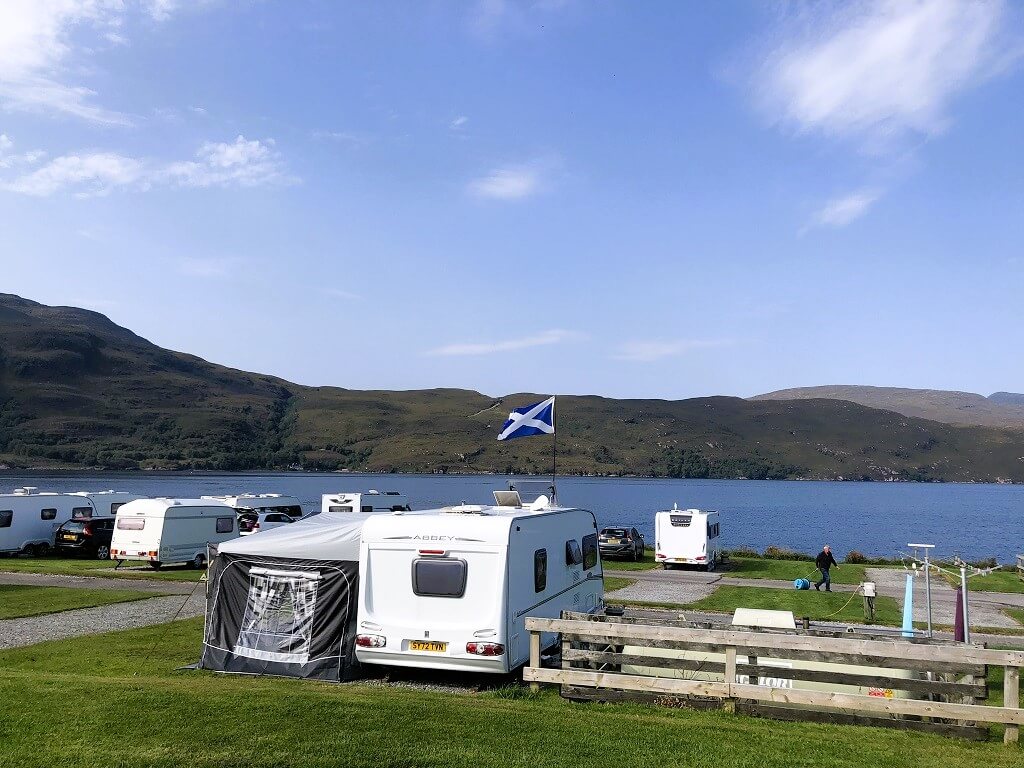
There weren’t as many motorhomes on the road as I’d expected (although there were loads at Broomfield Holiday Park in Ullapool). The benefit of a motorhome is having everything you need in your vehicle but the downside is navigating the roads and finding suitable parking places.
If you’re travelling with several children in tow, a small motorhome would be a great solution as you don’t have to spend ages packing tents away each morning.
NC500 with a caravan
If you’re keen to tackle some of the more remote sections of the NC500, I think towing a caravan could be an issue. Some of the roads are very narrow with sharp bends on inclines which could prove challenging if there’s a lot of traffic and you have a long caravan.
However, using a caravan is good value and you have a home on wheels – ideal when the weather is bad.
What are the roads like on the NC500?
We thought the roads on the NC500 were excellent. They are well maintained and there are passing places everywhere we went, with signs giving you notice in advance. The roads were really quiet during our early August visit. We didn’t make it to the famous Bealach na Bà pass so I can’t comment on how busy or tricky it was to drive but everywhere else we went, including the Drumbeg Loop, was good.

What is the phone signal like on the NC500?
For the most part, we found the phone signal to be fairly good. There were times where we had no signal but it didn’t last for long.
If you are camping and you like to have a charged phone, make sure you bring a power bank.
What to pack for the NC500
As we travelled by train and the company we hired our car from provided everything we needed for our NC500 camping trip, we kept packing to a minimum.
Aside from whatever clothes, toiletries and other items you want to pack, I’d also recommend the following:
- Lots of lightweight layers
- Waterproof trousers, jacket and footwear
- Wetsuit – the sea felt fine once I’d put mine on!
- Hat (for sun protection, for warmth, or to keep your hair from blowing in your face)
- Insect repellent – Smidge and Avon Skin So Soft seem to be the main recommendations
- Powerbank for your tech
What are the best things to see and do on the NC500?
This is very subjective – some visitors to the north coast of Scotland come for the castles, others come for the whiskey. However, without doubt everyone comes for the fantastic scenery. The views were the highlight for me, particularly along the west coast.
Other highlights included swimming and paddle boarding in the crystal clear sea (the water wasn’t as cold as I’d expected, although I was wearing a wetsuit); hiking, discovering waterfalls and walking along deserted beaches. There were so many beautiful, empty beaches.